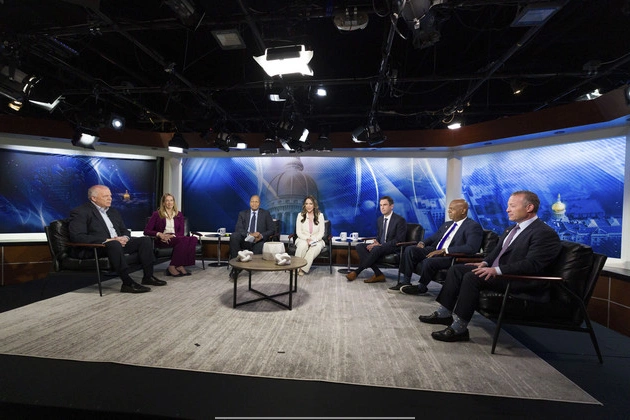
The Democratic primary for New Jersey governor has taken on the intensity of a general election in its final days.
Rep. Mikie Sherrill, the perceived frontrunner, faces attacks from primary opponents regarding past stock trades and donations, focusing her attention on Republican Jack Ciattarelli, Trump’s favored candidate.
The Unpredictable Race
The New Jersey governor’s race, especially on the Democratic side, is unusually uncertain due to the absence of the county line advantage, testing the strength of the political establishment.
Despite Sherrill’s backing from party insiders, all six Democratic contenders struggle to distinguish themselves, with close polling indicating a tight race. In contrast, Ciattarelli holds a more significant lead over his primary rival, Bill Spadea.
Each Democrat envisions a path to victory, relying on high turnout and untraditional primary voters to surpass Sherrill. The absence of historical turnout patterns complicates predictions, given the candidates’ overlapping support bases.
The Election Dynamics
In a potentially low-turnout race, victory could hinge on a few thousand votes, emphasizing the impact of a small subset of voters.
Sherrill’s unique position as the sole female candidate could sway female voters, whose higher turnout rates may influence the outcome. Her campaign’s targeted messaging aims to resonate with specific demographics, leveraging digital platforms for outreach.
Despite positioning as a frontrunner, Sherrill’s campaign recognizes the undecided voter segment, emphasizing the need for continued engagement and persuasion.
Campaign Strategies and Finances
As election week unfolds, candidates intensify advertising efforts to boost visibility. Sherrill leads in ad spending, followed by Gottheimer, with varying investment levels from other contenders.
The altered ballot design in New Jersey adds uncertainty, disrupting past voting patterns and favoring candidates with strong local party support.
County endorsements and turnout machinery influence early voting trends, with Sherrill securing significant North Jersey backing. However, the distribution of votes within endorsed counties remains unpredictable in the absence of a clear frontrunner.
Key endorsements and financial backing shape candidates’ outreach strategies, targeting specific voter segments based on geography, demographics, and policy priorities.
The Path to Victory
New Jersey’s Democratic primary landscape reflects broader party debates on voter engagement strategies, balancing appeals to moderates and energizing the party base.
Candidates like Newark Mayor Ras Baraka and Jersey City Mayor Steven Fulop embody distinct campaign narratives, mobilizing different voter blocs around progressive or anti-establishment messages.
Policy platforms focused on affordability, community engagement, and identity-based appeals characterize candidate differentiation, aiming to secure critical voter blocs in a fragmented field.
With high stakes and unpredictable turnout dynamics, the Democratic primary in New Jersey signifies a pivotal moment for party redefinition and electoral strategy.