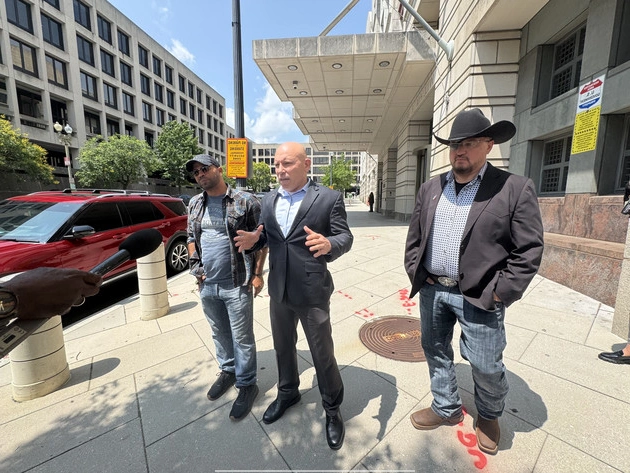
When Stewart Rhodes and Enrique Tarrio entered the federal courthouse in Washington, D.C., they were notably clad in jeans instead of jumpsuits.
Described by federal judges as key instigators of the Jan. 6, 2021, conspiracy to disrupt the transfer of power from Donald Trump to Joe Biden, Rhodes and Tarrio received significant sentences. Rhodes was handed an 18-year term, while Tarrio faced a 22-year sentence, the longest among all defendants involved in the January 6th event.
Showing Support at Lamond’s Sentencing
On the first day of his second term, Trump nullified their prison sentences by granting a broad amnesty to over 1,500 individuals charged or convicted in connection with the Capitol breach nearly five years ago.
Present in the courthouse, the two men engaged with a small group of supporters, gearing up to confront a federal judge overseeing the sentencing of Shane Lamond, an associate of Tarrio and a former D.C. police officer.
Rhodes and Tarrio asserted their presence at Lamond’s trial to express solidarity with a man they believed deserved a presidential pardon. Lamond was found guilty of providing false information to federal investigators and fellow officers to shield Tarrio from an inquiry into his burning of a Black Lives Matter flag prior to Jan. 6.
Initially seeking information from Lamond, Tarrio ended up divulging details about the flag-burning investigation while Lamond reciprocated by sharing confidential data about his colleagues’ activities—culminating in a web of lies. Lamond was sentenced to 18 months in prison by U.S. District Judge Amy Berman Jackson, who reprimanded him for tarnishing the reputation of his badge and department. During Lamond’s trial, Tarrio, still incarcerated at the time, testified on his behalf, leading to a contentious courtroom session described by Jackson as ‘bizarre.’
Lamond’s sentencing marked one of the few instances in Trump’s second term where an individual connected, albeit indirectly, to the events of Jan. 6 faced legal repercussions. While the alleged masterminds of the assault roamed freely in the public gallery, Lamond learned of his impending incarceration in August. Notably, the Trump administration’s Department of Justice urged Judge Jackson to imprison Lamond for four years, a request she deemed ‘excessive’ and rejected.
Appealing for Pardons Outside the Courthouse
Post the sentencing, Rhodes and Tarrio stood outside the courthouse, urging Trump to pardon Lamond and other Jan. 6 defendants whose sentences were commuted instead of receiving full pardons. Accompanying them was Ivan Raiklin, a long-time ally of Trump, advocating for retribution against those targeting Jan. 6 defendants and demanding investigations into the Capitol Police leadership.
Despite being seen with Trump at Mar-a-Lago recently, Tarrio refrained from disclosing details of his interaction with the President, describing it as ‘brief.’
Both Rhodes and Tarrio expressed frustration over the leniency shown by the Trump administration towards Biden-era prosecutors, some of whom continued to hold positions within the government. Rhodes specifically called on the interim U.S. Attorney, Jeanine Pirro, to purge additional prosecutors associated with the Jan. 6 investigations.
Interestingly, one of the prosecutors involved in Rhodes’ conviction was present at Lamond’s trial, seated merely a few feet away from his former adversary. Rhodes described the encounter as ‘bizarre,’ emphasizing his lack of appreciation for the prosecutor’s presence.